Veterinary Documentation Efficiency: Reducing After-Hours Notes
Struggling with after-hours medical records? Discover practical strategies to improve veterinary documentation efficiency and reclaim your team's time.
By Helpful.vet Team
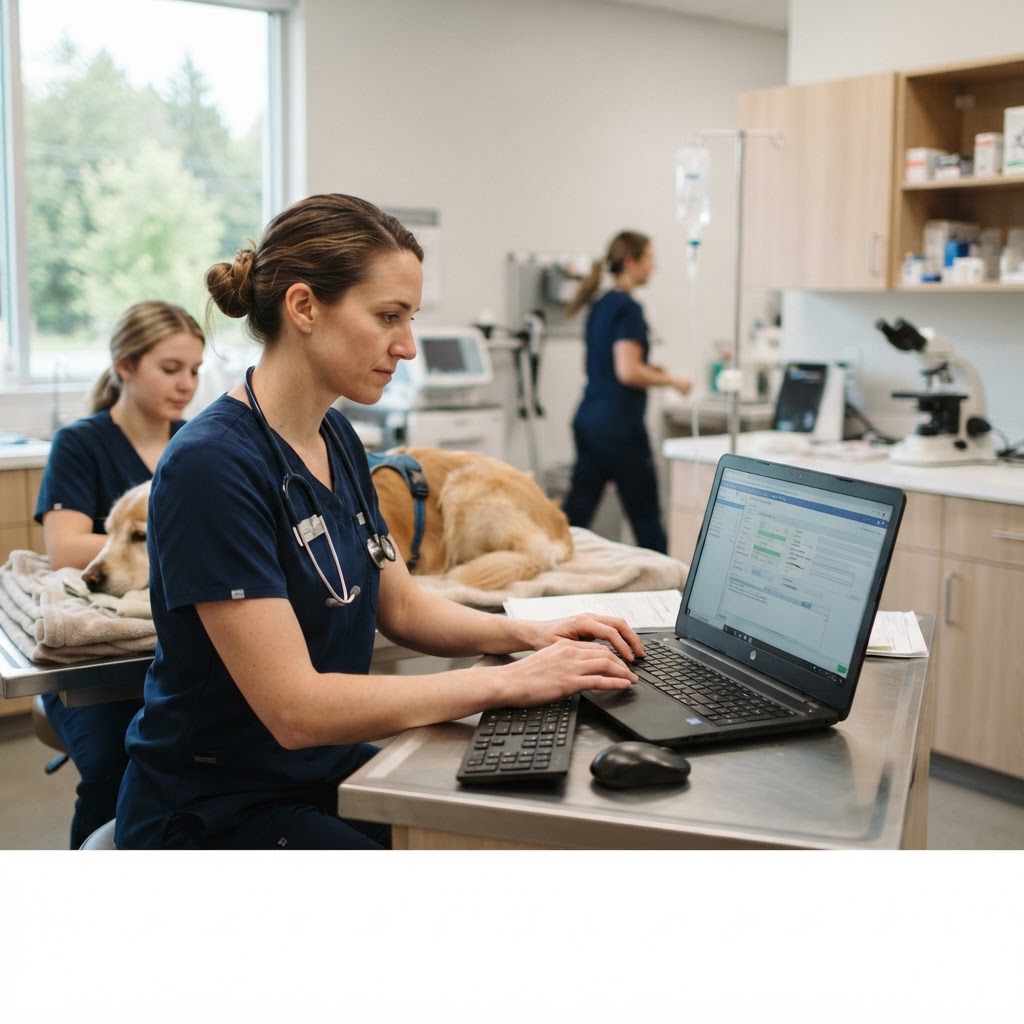
Veterinary documentation efficiency is one of the most critical factors in preventing burnout and maintaining a sustainable general practice. When veterinarians and technicians spend hours after their shifts reconstructing patient histories from memory, it creates a cascade of operational bottlenecks. Improving veterinary documentation efficiency requires a combination of standardized workflows, strategic delegation, and the right technology.
The Cost of Delayed Documentation
Incomplete or delayed documentation creates cascading inefficiencies throughout your practice. According to industry analyses, inefficient practices lose significant time per appointment compared to high-performing peers [Veterinary Practice Efficiency: The Complete Playbook](https://co.vet/post/veterinary-efficiency/). When medical records are delayed, client communication suffers, billing accuracy drops, and team members waste time searching for critical patient information. Real-time documentation eliminates this cascade entirely. Instead of reconstructing patient histories from memory, capturing complete medical record-keeping as you examine the patient ensures accuracy and saves hours of administrative time.
The Four Stages of Practice Efficiency
Most veterinary clinics fall into predictable efficiency categories when it comes to documentation and workflow. Understanding your current stage is the first step toward improvement.
- The Firefighter: Clinics operating in constant reactive mode. Documentation piles up, and basic protocols get skipped when things get hectic.
- The Juggler: Systems exist but do not communicate well. Team members enter the same patient information multiple times across different platforms.
- The Builder: The clinic is ready for systematic workflow optimization, focusing on standardized templates and clear role delegation.
- The Innovator: Efficiency leaders who maintain a competitive advantage by using advanced tools like AI dictation and predictive scheduling.
To see where your practice stands, consider using our GP Clinic Workflow Score to identify specific bottlenecks in your daily operations.
Strategies for Real-Time Documentation
Achieving real-time veterinary documentation efficiency requires a shift in both clinic culture and daily habits. Here are practical steps to implement immediately:
1. Implement Concurrent Charting
Train your team to chart during the appointment rather than saving it for the end of the day. Have a veterinary technician or assistant act as a scribe during complex exams. This allows the veterinarian to focus entirely on the patient and the client while ensuring that the medical record is updated in real-time.
Where is your workflow slowing down?
Take the free 3-minute GP Clinic Workflow Score and see where your daily workflow is strong, where friction builds up, and what to improve first.
Get Your Workflow Score2. Utilize Veterinary Dictation Software
Typing speed is a common bottleneck. Modern veterinary dictation software can capture complete medical records as you speak, significantly reducing the time spent on data entry [Veterinary Practice Efficiency: The Complete Playbook](https://co.vet/post/veterinary-efficiency/). These tools are specifically trained on veterinary terminology, ensuring high accuracy and allowing doctors to complete their notes before the next patient walks into the exam room.
3. Standardize Templates and Macros
Create comprehensive templates for common presentations (e.g., wellness exams, otitis externa, vomiting). Pre-filled macros allow the team to simply adjust the abnormal findings rather than typing the entire physical exam from scratch. Ensure these templates are universally adopted across the practice to maintain consistency.
Optimizing the Discharge Process
Documentation efficiency directly impacts the client discharge process. If notes are incomplete, discharge instructions are often rushed or missing critical details. Elite veterinary hospitals focus on a standard discharge process to ensure clients receive the best care possible [Supercharging Veterinary Discharge Workflows](https://instinct.vet/blog/supercharging-veterinary-patient-discharge-workflows/).
- Automate Care Plans: Use software that formats clinic-approved instructions into clear care plans and follow-up prompts [Veterinary Discharge Instructions Software | VetFable](https://vetfable.com/solutions/veterinary-discharge-instructions-software).
- Avoid Jargon: Write discharge instructions at an accessible reading level and avoid complex veterinary terminology [How to perfect the discharge instructions](https://vetcheck.it/discharge/).
- Delegate Client Education: Empower credentialed technicians to review discharge instructions and medications with the pet owner, freeing up the veterinarian to move on to the next appointment [4 tips for an effective discharge](https://www.dvm360.com/view/4-tips-effective-discharge).
Measuring Your Success
To ensure your new workflows are effective, track leading indicators rather than just appointment volume. Measure how long each DVM spends on notes after appointments end, and count how many times patient information gets entered into different systems. By establishing a baseline and tracking these metrics over a 90-day period, you can systematically reduce after-hours documentation and dramatically improve your team's quality of life.

Helpful.vet Team
ContributorA veterinary professional contributing practical insights to Helpful.vet.
More about Helpful.vetFrequently asked questions
Implement concurrent charting by using technicians as scribes during exams. Additionally, utilizing veterinary-specific dictation software and standardized templates can drastically cut down on manual typing time.
The most common mistake is adding new technology without fixing underlying workflow problems. Clinics must first standardize their processes and clarify team roles before implementing new software solutions.
When medical records are completed in real-time, discharge instructions and treatment plans can be generated accurately and promptly. This ensures clients receive clear, comprehensive information without waiting, which improves compliance and satisfaction.
Medical disclaimer: Helpful.vet provides educational and workflow-related information for veterinary professionals. It does not provide medical advice, diagnosis, or treatment recommendations. Clinical decisions should always be made by a licensed veterinarian using patient-specific history, examination findings, diagnostics, and professional judgment. See our full medical disclaimer.
Get more practical GP tools in your inbox
Short, useful resources for veterinary practice teams.