How to Reduce Veterinary Inventory Shrinkage in GP Clinics
Inventory shrinkage is a silent profit killer in general practice. Learn the most common causes of missing stock and how to implement practical workflows to protect your clinic's margins without slowing down your team.
By Helpful.vet Team
Veterinary inventory shrinkage is one of the most persistent, yet preventable, profit drains in general practice. While most clinic owners focus on increasing appointment volume or optimizing exam room efficiency, thousands of dollars often slip through the cracks in the pharmacy and stockroom. Shrinkage happens gradually through daily operations—a medication administered during an emergency but not logged, vaccines that expire before use, or physical counts that simply do not match the practice management system (PIMS). Without strong inventory controls, these small, incremental losses compound into a significant financial impact that directly reduces your bottom line.
For busy GP teams, understanding why veterinary inventory shrinkage occurs and implementing structured workflows to prevent it is essential for protecting revenue while maintaining high standards of clinical care. By addressing the root causes of missing inventory, clinics can improve their GP Practice Benchmark Tool metrics and ensure that the team always has the supplies they need to treat patients effectively.
What is Veterinary Inventory Shrinkage?
Veterinary inventory shrinkage is the gap between the inventory a hospital expects to have based on its records and what is actually sitting on the shelves. It is the unplanned loss of physical goods that reduces asset value and increases operating costs. In a veterinary setting, inventory typically represents the second-largest expense after payroll, often accounting for 15% to 20% of a clinic's gross revenue. When shrinkage occurs, you are not just losing the cost of the product; you are losing the potential markup and revenue that product would have generated.
While the term "shrinkage" is often associated with theft in the retail sector, the reality in veterinary medicine is much different. The vast majority of inventory loss in a GP clinic is the result of broken workflows, undocumented usage, and administrative errors. When a veterinary technician is rushing to stabilize a critical patient, logging a used catheter or a dose of medication into the PIMS is rarely their first priority. If that usage is never retroactively recorded, shrinkage occurs.
The True Cost of Inventory Shrinkage in GP Clinics
To understand the urgency of managing shrinkage, it is helpful to look at the numbers. Industry benchmarks suggest that a well-managed veterinary clinic should maintain an inventory shrinkage rate of less than 1.5%. However, many clinics operate with shrinkage rates between 2% and 5% without even realizing it.
Consider a general practice that purchases $250,000 worth of inventory annually. A 3% shrinkage rate equates to $7,500 in lost goods. However, because veterinary clinics typically mark up inventory by 100% to 150% (plus dispensing fees), that $7,500 in lost goods actually represents $15,000 to $18,750 in lost revenue. Over a five-year period, that is nearly $100,000 vanished from the practice's bottom line due to poor inventory control.
5 Common Causes of Veterinary Inventory Shrinkage
To effectively combat inventory loss, practice managers and owners must first identify where the leaks are occurring. Here are the five most common drivers of shrinkage in general practice.
1. Undocumented Usage and Missed Charges
This is the leading cause of inventory shrinkage in veterinary medicine. It occurs when a product is used on a patient or dispensed to a client, but the charge is never entered into the PIMS. This frequently happens during chaotic moments—such as working in a busy treatment area, handling walk-in emergencies, or managing double-booked exam rooms. Items like bandages, fluids, syringes, and in-house medications are highly susceptible to undocumented usage. If your team relies on memory to enter charges at the end of a shift, missed charges are guaranteed.
2. Expired Medications and Spoilage
When inventory is not properly rotated, older products get pushed to the back of the shelf and expire before they can be used. This is particularly common with vaccines, specialized diets, and rarely used emergency drugs. Spoilage also occurs when cold-chain protocols are broken—for example, if a refrigerator door is left ajar overnight, ruining thousands of dollars worth of biologics. Expired products must be thrown away, resulting in a 100% loss of the purchase price.
3. Administrative and Receiving Errors
Shrinkage often begins the moment a delivery arrives at the clinic. If a staff member signs for a package and puts the items on the shelf without verifying the contents against the packing slip and the original purchase order, the clinic may pay for items it never received. Additionally, if the received quantities are not accurately entered into the PIMS, the system's expected inventory will immediately be out of sync with reality.
4. Overstocking
Fear of running out of essential supplies often drives clinics to over-order. While it might seem safer to have a massive surplus of antibiotics or preventatives, overstocking ties up working capital and drastically increases the risk of expiration and damage. A cluttered pharmacy also makes it incredibly difficult to perform accurate physical counts, allowing shrinkage to go unnoticed for months.
5. Internal Theft
While no one wants to suspect their team, internal theft does occur. This can range from a staff member taking a bag of dog food or a box of flea prevention for their own pet without paying, to the much more serious diversion of controlled substances. Without locked cabinets and strict auditing protocols, high-value items are vulnerable.
Where is your workflow slowing down?
Take the free 3-minute GP Clinic Workflow Score and see where your daily workflow is strong, where friction builds up, and what to improve first.
Get Your Workflow ScoreHow to Calculate Your Clinic's Shrinkage Rate
You cannot manage what you do not measure. To determine your clinic's shrinkage rate, you need to perform a physical inventory count and compare it to the expected inventory recorded in your PIMS. The formula is straightforward:
Inventory Shrinkage Rate = [(Expected Inventory Value - Actual Physical Inventory Value) / Expected Inventory Value] x 100
For example, if your PIMS states you should have $50,000 worth of inventory on hand, but your physical count reveals only $48,500, your shrinkage is $1,500. Divided by $50,000, this equals a shrinkage rate of 3%. If your rate is above 1.5%, it is time to audit your workflows using tools like the GP Clinic Workflow Score to identify operational bottlenecks.
Step-by-Step Workflow to Reduce Veterinary Inventory Shrinkage
Reducing shrinkage does not require a massive overhaul of your clinic; it requires consistent, repeatable workflows. Implement the following strategies to tighten your inventory control.
1. Implement Cycle Counting Instead of Annual Audits
Relying on a single, massive inventory count at the end of the year is a recipe for disaster. By the time you discover a discrepancy, months have passed, making it impossible to determine how or why the item went missing. Instead, implement cycle counting. Cycle counting involves counting a small subset of your inventory on a continuous, rotating schedule. For example:
- Week 1: Count all parasiticides and preventatives.
- Week 2: Count all antibiotics and pain medications.
- Week 3: Count all retail items and prescription diets.
- Week 4: Count all vaccines and injectables.
Controlled substances should be counted daily or weekly, depending on local regulations and clinic volume. Cycle counting takes only 15 to 30 minutes a week, keeps your PIMS accurate year-round, and allows you to catch and correct workflow errors immediately.
2. Standardize the Receiving Process
Create a strict protocol for receiving shipments. Only designated personnel should be allowed to check in inventory. The workflow should be:
- Open the box and physically count every item.
- Compare the physical items to the packing slip to ensure the vendor shipped the correct quantities.
- Compare the packing slip to the original purchase order to ensure you are only receiving what you actually ordered.
- Enter the received quantities and updated expiration dates into the PIMS immediately.
- Put the items away using the FIFO method.
3. Enforce First-In, First-Out (FIFO)
To eliminate spoilage, every staff member must follow the FIFO rule: First-In, First-Out. When new inventory arrives, it must be placed behind the existing inventory on the shelf. This ensures that the products with the earliest expiration dates are used first. Use brightly colored "Use First" stickers on older bottles to draw the team's attention.
4. Lock Down High-Value Items
Not all inventory requires the same level of security. While it is fine to leave syringes and bandages on open shelving, high-value items (like expensive preventatives, specialized injectables, and certainly controlled substances) should be kept in a locked cabinet or a dedicated inventory dispensing machine. Limiting access reduces the temptation for theft and forces staff to be more mindful when retrieving expensive items.
5. Integrate PIMS with Clinical Workflows
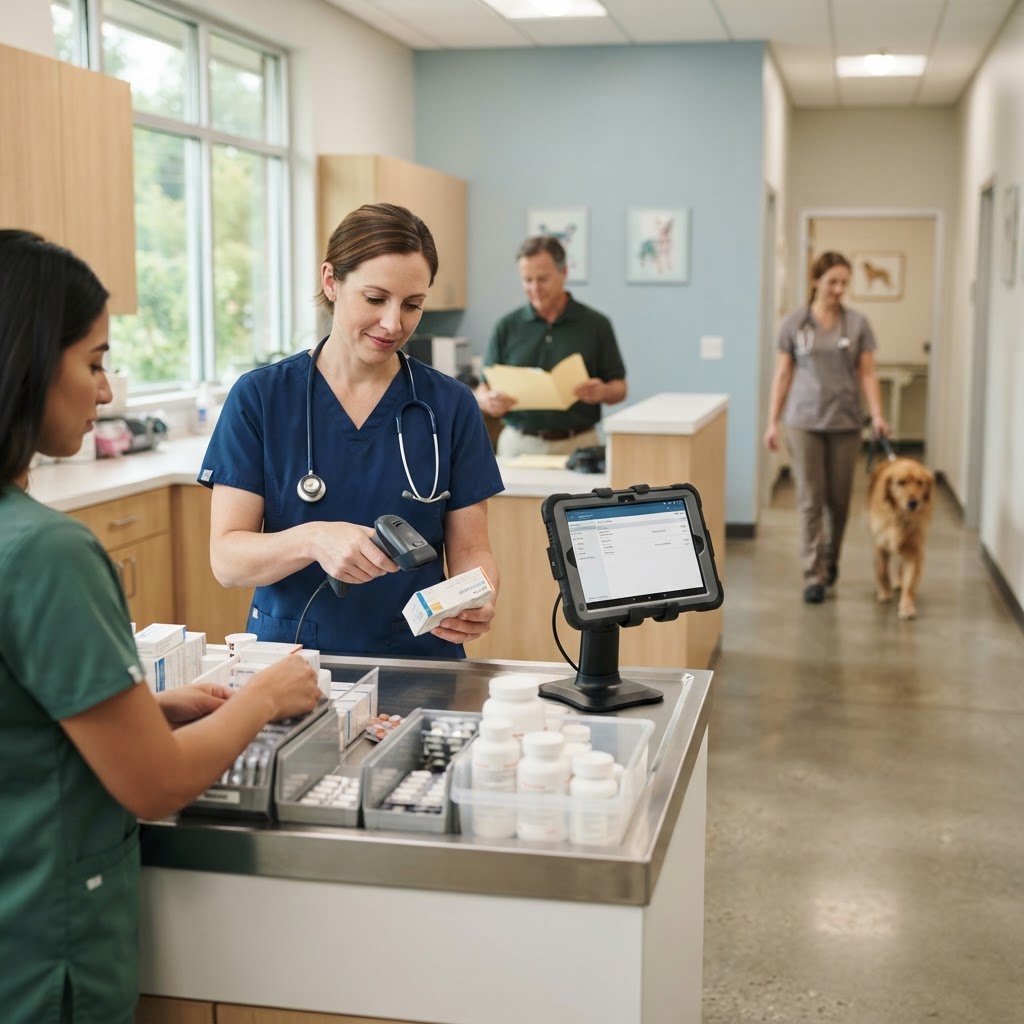
To prevent missed charges, the clinical workflow must be tied directly to the billing workflow. Utilize the travel sheet or digital whiteboard features in your PIMS. Train your technicians to enter charges at the exact moment a treatment is performed, rather than waiting until the end of the appointment. If your clinic struggles with this, consider implementing barcode scanners in the pharmacy and treatment areas. Scanning a product immediately deducts it from inventory and adds it to the patient's invoice, drastically reducing human error.
The Role of the Veterinary Inventory Manager
In many GP clinics, inventory management is treated as a shared responsibility. The problem with this approach is that when everyone is in charge of inventory, no one is actually accountable for it. To effectively reduce shrinkage, you must appoint a dedicated Inventory Manager.
This individual (often a senior veterinary technician or practice manager) should be solely responsible for ordering, receiving, cycle counting, and analyzing inventory reports. While other staff members will still pull medications and stock shelves, the Inventory Manager oversees the systems and ensures compliance. Give this person dedicated administrative time each week—usually 2 to 4 hours depending on clinic size—to perform these duties without the distraction of patient care.
Action Plan for GP Teams
Reducing veterinary inventory shrinkage is an ongoing process, but you can start making improvements today. This week, take the following three steps:
- Run an inventory valuation report: Pull the current expected inventory value from your PIMS to establish a baseline.
- Schedule your first cycle count: Pick one high-value category (e.g., flea and tick preventatives) and perform a physical count this Friday. Compare it to the PIMS and investigate any discrepancies.
- Appoint an inventory lead: Identify the most organized person on your team and officially delegate the receiving and auditing workflows to them, ensuring they have the blocked time required to succeed.
By treating your inventory with the same care and precision as your clinical protocols, you will protect your practice's profitability and ensure your team always has the resources they need to provide excellent patient care.

Helpful.vet Team
ContributorA veterinary professional contributing practical insights to Helpful.vet.
More about Helpful.vetFrequently asked questions
While zero shrinkage is the ultimate goal, a realistic benchmark for a well-managed veterinary clinic is below 1.5% of total inventory value. Anything above 2% indicates significant workflow gaps, such as missed charges or receiving errors, that require immediate auditing.
Instead of a single massive annual count, clinics should implement weekly or monthly cycle counts. High-value items and controlled substances must be counted daily or weekly, while lower-value consumables can be counted on a rotating quarterly basis.
The most common cause is undocumented usage, often referred to as missed charges. This typically happens during emergencies or busy shifts when staff administer medications or use supplies but forget to log them into the practice management system.
Medical disclaimer: Helpful.vet provides educational and workflow-related information for veterinary professionals. It does not provide medical advice, diagnosis, or treatment recommendations. Clinical decisions should always be made by a licensed veterinarian using patient-specific history, examination findings, diagnostics, and professional judgment. See our full medical disclaimer.
Get more practical GP tools in your inbox
Short, useful resources for veterinary practice teams.