Veterinary Surgical Discharge Workflows: Reducing Callbacks
Discover how to standardize your veterinary surgical discharge workflow to improve client comprehension, reduce post-op callbacks, and save your GP team time.
By Helpful.vet Team
How many times has your front desk fielded a panicked phone call from a client an hour after picking up their pet from surgery, asking if the bandage is supposed to look like that or if they should give the pain medication tonight? If this sounds familiar, your clinic is experiencing the costly friction of an unoptimized veterinary surgical discharge workflow.
Research shows that client recall of medical instructions can be surprisingly low. In fact, one study found that the raw percentage of agreement between clinicians and clients regarding discharge instructions was only 68.9% on the day of discharge, dropping further when questions involved adverse medication effects or confinement instructions [7]. For busy general practice (GP) teams, these misunderstandings translate directly into bottlenecked phone lines, frustrated staff, and compromised patient care.
By standardizing your veterinary surgical discharge workflow, you can proactively address client confusion, empower your veterinary technicians, and reclaim hours of lost time each week. Here is a practical guide to building a foolproof post-op discharge process.
The Cost of a Poor Veterinary Surgical Discharge Workflow
When a veterinary surgical discharge workflow is rushed or disorganized, the ripple effects are felt throughout the entire clinic. Veterinarians end up staying late to write notes, technicians are pulled away from active treatments to answer basic phone questions, and clients feel unsupported during a highly stressful time.
- Increased Call Volume: Confused clients call back multiple times, tying up customer service representatives (CSRs) and delaying care for other patients.
- Decreased Compliance: If clients do not understand how to administer medications or enforce strict rest, the patient's recovery is jeopardized.
- Staff Burnout: Constantly repeating the same instructions and managing preventable complications contributes heavily to team fatigue.
To see how your current processes stack up against industry benchmarks, consider using our GP Clinic Workflow Score tool to identify specific bottlenecks in your daily operations.
4 Steps to Optimize Your Veterinary Surgical Discharge Workflow
A successful veterinary surgical discharge workflow does not start when the client walks through the door at 5:00 PM; it begins the moment the patient is dropped off in the morning. Implementing a phased approach ensures nothing falls through the cracks.
1. Pre-Discharge Preparation (The Morning Of)
The most common mistake GP clinics make is waiting until the end of the day to prepare discharge materials. This guarantees a chaotic afternoon. Instead, shift the administrative burden to the morning or early afternoon.
- Draft Instructions Early: Have the attending veterinarian or lead technician draft the discharge instructions as soon as the procedure is finished and the patient is recovering.
- Prepare Medications: Fill, label, and double-check all take-home medications hours before the client arrives. Place them in a designated discharge bin alongside the printed instructions and any necessary physical items (e.g., E-collars).
- Send Digital Pre-Reading: Email the discharge instructions and relevant educational videos to the client before they arrive. This allows them to process the information at their own pace and come prepared with specific questions.
2. Standardizing Veterinary Discharge Instructions
Consistency is the foundation of a reliable veterinary surgical discharge workflow. If every doctor writes their own instructions from scratch, clients receive mixed messaging, and the risk of omitting crucial details skyrockets.
Where is your workflow slowing down?
Take the free 3-minute GP Clinic Workflow Score and see where your daily workflow is strong, where friction builds up, and what to improve first.
Get Your Workflow ScoreCreate standardized templates in your Practice Management Information System (PIMS) for common GP procedures, such as spays, neuters, mass removals, and dental extractions. Every template should clearly outline:
- Medication Schedule: Exactly when to give the next dose (e.g., "Give the first dose of Gabapentin tonight at 8:00 PM with food").
- Incision Care: What a normal incision looks like versus signs of infection (redness, swelling, discharge).
- Activity Restrictions: Define "strict rest" clearly (e.g., "Leash walks only for bathroom breaks; no running, jumping, or stairs for 10 days").
- Emergency Contacts: Who to call if an issue arises after hours.
3. The Technician Discharge Appointment
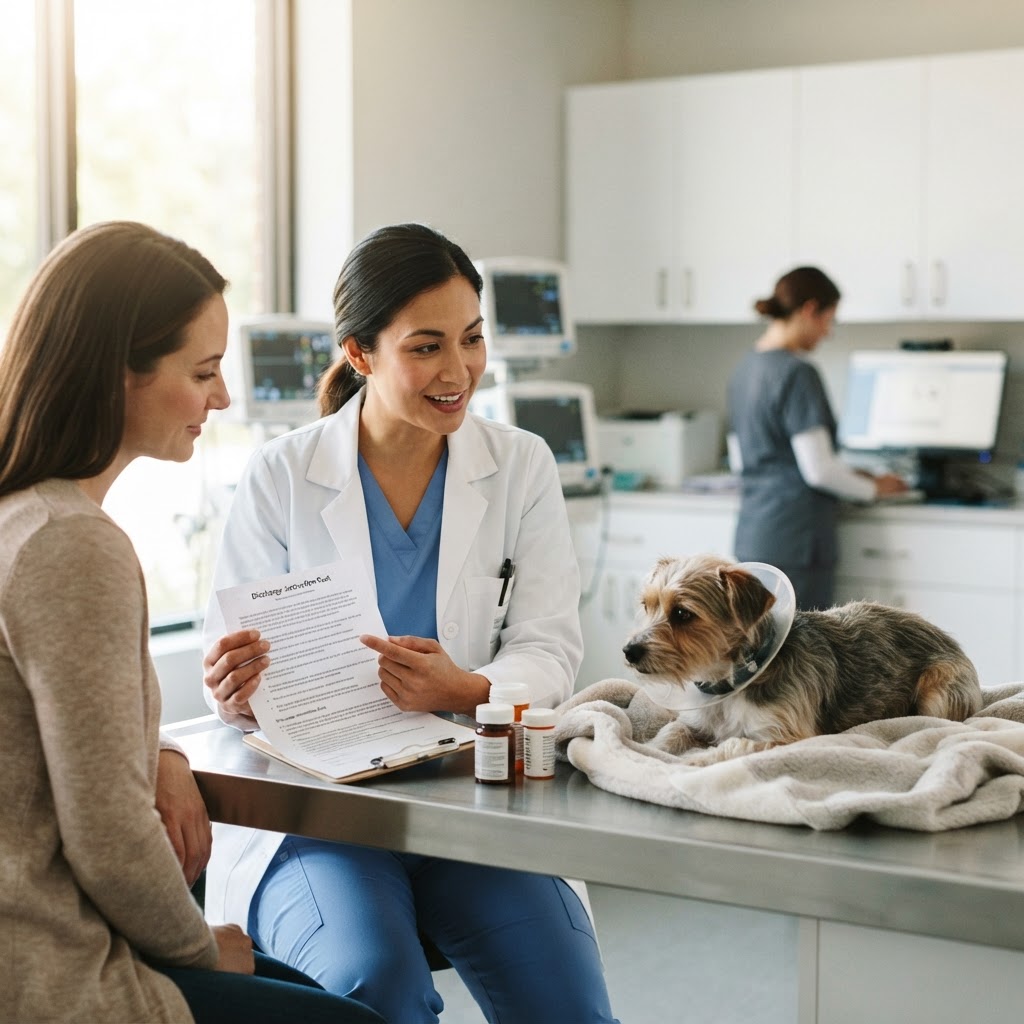
Discharging a patient is a prime opportunity for task delegation. Veterinarians should rarely perform routine surgical discharges. Instead, empower your credentialed veterinary technicians or highly trained assistants to lead these appointments.
"Effective delegation of the discharge process not only saves the veterinarian 10 to 15 minutes per patient but also elevates the role of the technician, fostering a more engaged and utilized team."
To keep these appointments efficient:
- Review Without the Pet: Bring the client into a quiet exam room and review the written instructions and medications before bringing the pet into the room. Once the pet is present, the client's attention will be entirely on their animal, and they will not hear a word you say.
- Demonstrate Techniques: Show the client how to put on and take off the E-collar, and demonstrate how to administer oral medications if they are inexperienced.
- Use the Teach-Back Method: Ask the client to repeat the most critical instructions back to you (e.g., "Just to make sure I explained it clearly, when are you going to give the next dose of pain medication?").
If you want to evaluate how effectively your team is communicating these critical points, our Client Communication Score tool can provide actionable insights.
4. The 24-Hour Follow-Up Call
A proactive veterinary surgical discharge workflow includes a scheduled follow-up. Assign a CSR or assistant to call every surgical client the morning after the procedure. This preemptive strike catches minor misunderstandings before they escalate into major complications or angry phone calls.
Keep the call brief and focused: "Hi, this is Sarah from Helpful Vet Clinic checking on Bella. Did she eat her breakfast this morning, and were you able to give her the pain medication?"
Measuring Discharge Workflow Efficiency
To ensure your new veterinary surgical discharge workflow is actually working, track a few key metrics over a 30-day period. Monitor the number of post-op phone calls your front desk receives, the average time it takes to complete a discharge appointment, and the rate of post-op complications due to client non-compliance. By treating client communication as a core clinical competency, your GP clinic can deliver better patient care while simultaneously reducing team stress.

Helpful.vet Team
ContributorA veterinary professional contributing practical insights to Helpful.vet.
More about Helpful.vetFrequently asked questions
A routine surgical discharge should take 10 to 15 minutes. Providing written instructions and educational videos beforehand can help keep this appointment concise while ensuring client comprehension.
Credentialed veterinary technicians or trained veterinary assistants should handle routine surgical discharges. This delegates tasks effectively and frees up the veterinarian for other clinical duties.
Standardize your written veterinary discharge instructions and implement a proactive 24-hour follow-up call. Addressing common questions about pain management and incision care before the client leaves significantly reduces inbound calls.
Medical disclaimer: Helpful.vet provides educational and workflow-related information for veterinary professionals. It does not provide medical advice, diagnosis, or treatment recommendations. Clinical decisions should always be made by a licensed veterinarian using patient-specific history, examination findings, diagnostics, and professional judgment. See our full medical disclaimer.
Get more practical GP tools in your inbox
Short, useful resources for veterinary practice teams.