Maximizing Vet Clinic Revenue per Appointment: A 2026 Benchmarking Guide
Boost your vet clinic revenue per appointment without burnout. Our 2026 benchmarking guide offers practical tips for smarter workflows & better team utilizat...
By Sample Hubspot User

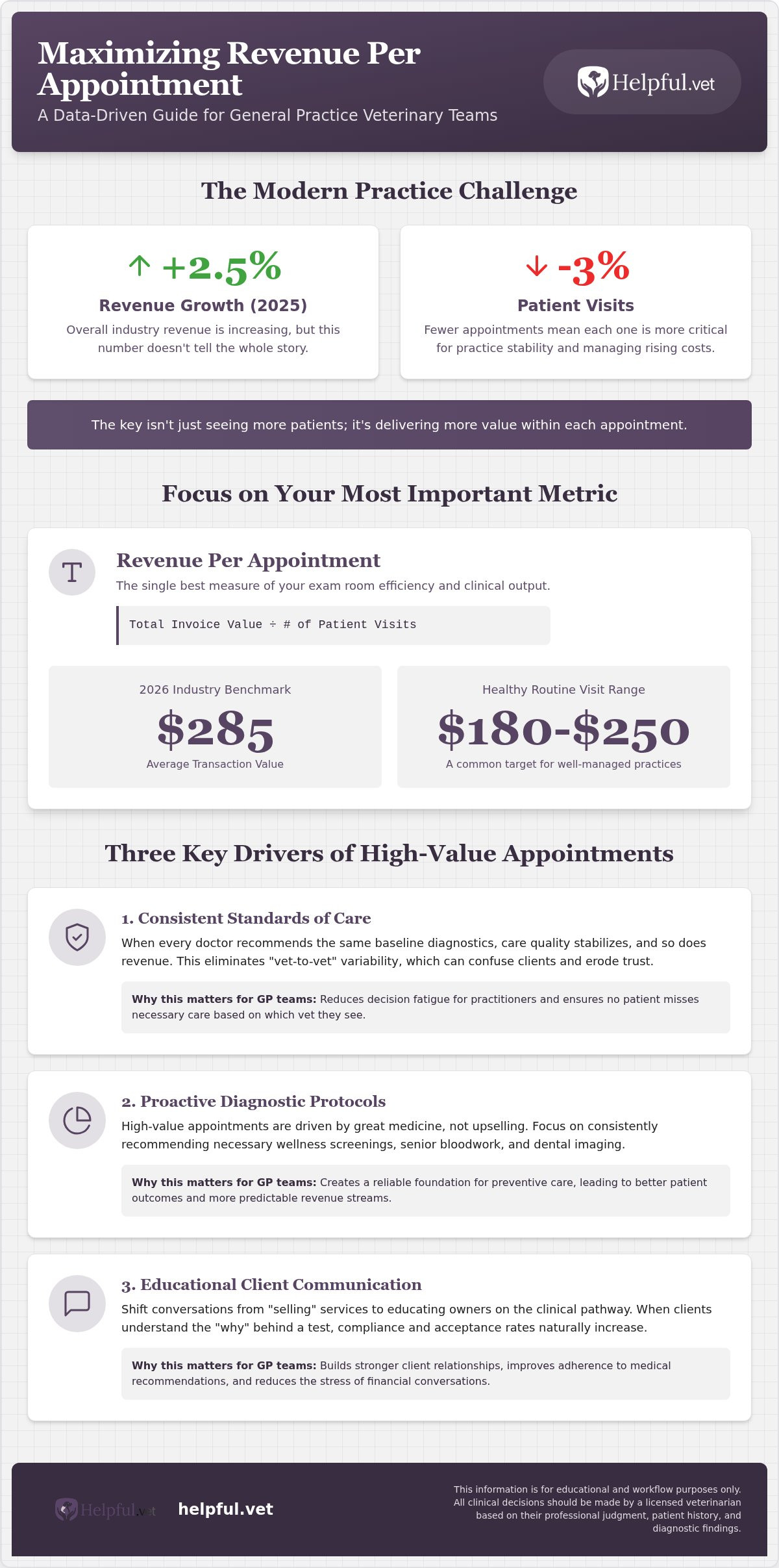
Did you know that while veterinary revenue grew by 2.5% in 2025, the number of actual patient visits dropped by nearly 3%? It's a frustrating reality for many general practices. You're likely working harder than ever to manage rising overhead and technician burnout, yet the traditional model of simply seeing more patients is hitting a ceiling. It often feels like a battle to explain the value of diagnostics to price-sensitive clients without extending your exam times or exhausting your team.
We understand that the goal isn't just to charge more; it's to practice better medicine more efficiently. This guide will show you how to stabilize your practice by maximizing your vet clinic revenue per appointment through smarter workflow density and consistent clinical standards. We'll explore the latest 2026 benchmarks, including the current average transaction value of approximately $285, and provide a practical framework to improve team utilization and diagnostic compliance. By focusing on data-driven benchmarking, you can increase your clinic's value while actually reducing the daily chaos for your staff.
Key Takeaways
- Understand how to calculate your vet clinic revenue per appointment to get a clear picture of your current exam room efficiency.
- Recognize that diagnostic consistency and wellness screenings are the most effective ways to increase appointment value naturally.
- Learn practical workflow adjustments, like improving team hand-offs, to boost revenue without adding time to the patient visit.
- Explore how forward booking ensures future revenue and helps your team stay organized and proactive.
- Use clinical benchmarking as a positive resource for professional growth and team alignment rather than a tool for judgment.
The Metric: Defining and Benchmarking Vet Clinic Revenue per Appointment
To understand your clinic's health, you need to look past the top-line numbers. Revenue per appointment is calculated by taking your total invoice value and dividing it by the number of unique patient visits. While gross revenue tells you how much money came in, this metric tells you how effectively your team utilized each exam room slot. In the current U.S. veterinary economic landscape, practitioners are finding that visit volume is decreasing while costs continue to rise. This makes every individual interaction more critical for the practice's stability.
Current 2026 benchmarks show that the average transaction value for a general practice is approximately $285. While a healthy range often sits between $180 and $250 for routine visits, well-managed clinics aim higher by focusing on revenue density. This isn't about rushing patients; it's about ensuring each 20 or 30 minute block is filled with high-value clinical work rather than administrative tasks. When you maximize your vet clinic revenue per appointment, you're ensuring that the time spent in the room reflects the full clinical expertise of your team.
Why Revenue per Appointment Trumps Gross Revenue for GP Teams
Gross revenue can be a deceptive metric. It often masks underlying issues like high client churn or a team that's over-scheduled and nearing burnout. If you're seeing 30 patients a day but your average invoice is low, you're working harder for less return. Tracking per-appointment value helps you identify gaps where diagnostic recommendations might be falling through the cracks. Tracking per-appointment value is the key to sustainable practice growth.
Identifying Your Baseline Performance
You don't need a degree in data science to find this number. Most PIMS allow you to pull a simple sales by category or transaction summary report. When you do this, it's helpful to separate product sales, like food or flea and tick preventatives, from clinical service revenue. This gives you a clearer picture of your team's medical output. To see how your clinic stacks up against current industry standards, you can use a GP practice benchmark tool to get an objective look at your performance.
Key Drivers of High-Value Appointments: Standards of Care and Diagnostics
High-value appointments aren't about upselling products or pushy sales tactics. They're about practicing medicine that aligns with your team's values. When every doctor in the practice recommends the same baseline diagnostics, your vet clinic revenue per appointment stabilizes. This consistency ensures that no patient misses out on necessary care simply because of which veterinarian they saw that day. It's a clinical approach that happens to have a positive financial outcome.
We often see missed opportunities in wellness screenings and dental assessments. These aren't just extras; they're essential parts of a proactive care plan. If a clinic isn't consistently recommending bloodwork for seniors or dental imaging for early-stage periodontal disease, the average appointment value drops. More importantly, the quality of care suffers. To get everyone on the same page, try using a standard of care self-check. It's a great way to align the medical team without making it feel like a performance review.
The Impact of Consistent Diagnostic Protocols
"Vet-to-vet" variability is a common challenge in GP practices. One doctor might recommend a full senior panel, while another suggests a "wait and see" approach. This inconsistency confuses clients and can erode trust. Standardized protocols solve this by reducing decision fatigue for busy practitioners. When the clinical pathway is clear, the team spends less time debating what to recommend and more time focusing on the patient. This structural clarity is a major driver of efficiency and revenue density.
Improving Client Communication for Better Compliance
Shift the focus from "selling" a service to educating the owner on a clinical pathway. Clients are more likely to accept recommendations when they understand the medical necessity behind the test. Your client communication score is a direct indicator of how well these conversations are going. Better communication leads to higher acceptance rates, which naturally supports your vet clinic revenue per appointment goals. If you're looking for more ways to support your team, consider joining our community newsletter for weekly workflow tips.
Workflow Adjustments to Increase Appointment Value Without Adding Time
Refining your workflow is about orchestration, not speed. Improving your clinic's financial performance doesn't require adding more hours to the day; it requires refining the movements within each appointment block. By optimizing the hand-off between technicians and veterinarians, you ensure that the doctor enters the room with a clear clinical picture and a prepared client. This synchronization is a primary driver of vet clinic revenue per appointment because it allows for thorough diagnostic work without causing the schedule to fall behind.
Maximizing Technician Utilization in the Exam Room
Empower your technicians to lead history taking and preliminary diagnostic discussions. When a technician explains the medical reasoning behind a senior screen or a dental assessment before the vet enters, it sets a professional tone for the visit. High technician utilization correlates with higher revenue because it frees the veterinarian to focus on complex diagnosis and treatment plans. It turns the appointment into a team effort where every member contributes to the standard of care.
Where is your workflow slowing down?
Take the free 3-minute GP Clinic Workflow Score and see where your daily workflow is strong, where friction builds up, and what to improve first.
Get Your Workflow ScoreReducing Exam Room Bottlenecks
Bottlenecks often occur during the transition between clinical work and administrative tasks. Identifying common time-wasters, such as searching for supplies or repetitive data entry, can save several minutes per patient. Implementing "Forward Booking" at the exam room computer rather than the front desk ensures that future value is captured before the client leaves. This practice alone helps stabilize your long-term revenue. For a deeper look at how to use your clinic's numbers to find these gaps, review this veterinary practice data insights guide for a practical roadmap.
You can also utilize technician-led appointments for follow-up care and routine screenings to keep the doctor's schedule open for more intensive cases. This strategy maximizes team utilization while maintaining a high level of patient care. To get more practical workflow tips delivered directly to your inbox, sign up for our weekly newsletter.
Implementing a Data-Driven Growth Strategy with Clinic Benchmarking
Data should be a source of clarity rather than a cause of stress. Benchmarking is a tool for professional development and team alignment, not a way to shame individuals for their numbers. When we look at vet clinic revenue per appointment, we aren't just looking at dollars; we're looking at how consistently we're delivering our chosen standard of care. Using data allows your team to move away from "gut feelings" and toward objective improvements that support both the patients and the practice's financial health.
The first step is understanding where you currently stand compared to your peers. You can start by using the GP practice benchmark tool to see how your metrics align with 2026 industry standards. Once you have a baseline, set small, incremental goals for the team. Targeting a massive revenue jump overnight is a recipe for burnout. Instead, focus on small wins, like increasing diagnostic compliance by 5% over the next quarter through better client communication.
Using Benchmarks for Continuous Improvement
It's easy to feel overwhelmed by spreadsheets. To keep the team engaged, always link performance metrics to the "Why this matters for GP teams" perspective. Higher revenue per appointment usually means more pets are getting the senior bloodwork they need or more dental disease is being treated before it becomes a crisis. Regular team meetings are essential to review these metrics and celebrate the wins. When the team sees that their efforts lead to better clinical outcomes, the data becomes a motivator rather than a chore.
Next Steps for Your Clinic
Implementation works best when it's manageable. Schedule a 15-minute data review with the management team this week to look at your current averages. From there, pick just one workflow change to incorporate per month. This slow and steady approach prevents the team from feeling like they're being pushed into a corporate sales model. By focusing on consistent, high-quality medicine, the financial growth will follow naturally.
Disclaimer: This information is for educational and workflow purposes only. It does not constitute medical or legal advice. All clinical decisions and diagnostic recommendations should be made by a licensed veterinarian based on the specific patient's history and findings.
Strengthening Your Practice for the Future
Practicing medicine in a shifting economy requires more than just seeing more patients. It's about ensuring every minute in the exam room reflects the high standard of care your team provides. By standardizing diagnostic protocols and empowering your technicians to lead clinical discussions, you can stabilize your vet clinic revenue per appointment without increasing the length of the workday. These small, data-driven adjustments reduce decision fatigue for your doctors and ensure that no patient is overlooked due to a busy schedule.
Moving toward a more efficient practice model is a journey of continuous improvement. Using interactive workflow tools designed for GP clinics and leveraging data-driven insights to support clinical excellence will help your team feel more organized and less reactive. When you focus on medical consistency, financial stability follows as a natural byproduct for the entire practice.
To stay informed on the latest benchmarking trends and clinical efficiency strategies, explore our GP Practice Benchmark Tool and sign up for our newsletter. Your commitment to clinical and operational excellence is what keeps your practice thriving, and we're here to support your team every step of the way.
Frequently Asked Questions
What is the average revenue per appointment for a veterinary clinic in 2026?
The average transaction value for companion animal practices in 2026 is approximately $285. While this number fluctuates based on location and patient mix, it serves as a reliable baseline for general practice teams. Tracking your specific vet clinic revenue per appointment against this figure helps you identify whether your current diagnostic recommendations align with industry standards. It provides an objective look at how effectively your team is capturing the medical value of every visit.
How can I increase my vet clinic revenue without raising prices?
Focusing on diagnostic compliance and wellness screenings is the most effective way to grow revenue without adjusting your price list. When you consistently recommend bloodwork, imaging, or dental assessments based on a patient's life stage, you're providing thorough medicine that naturally increases the invoice value. This method builds trust with clients because the costs are directly tied to proactive health outcomes for their pets rather than simple fee hikes.
Does higher revenue per appointment mean longer exam times?
Higher appointment value doesn't require longer exam times if your workflow is optimized for density. By utilizing technicians for history taking and preparing diagnostic recommendations early, you can complete thorough medical work within a standard 20 minute slot. The focus should be on reducing administrative bottlenecks so that the time spent in the exam room is dedicated to clinical expertise and client education rather than paperwork.
Why is technician utilization important for clinic revenue?
Technician utilization is vital because it maximizes the clinical output of the entire team. When technicians lead discussions on preventive care and diagnostics, it frees the veterinarian to focus on complex cases and surgery. This collaborative approach ensures that more medical needs are addressed during each visit, which naturally supports a higher vet clinic revenue per appointment while reducing the physical and mental workload on the doctor.
How often should a veterinary practice review its benchmarking data?
A monthly review of your benchmarking data is ideal for most general practices. This cadence allows you to identify shifts in clinical trends or workflow gaps without getting bogged down in daily variations. Reviewing these metrics once a month provides enough information to implement one small workflow change at a time. This ensures that your team remains focused on sustainable growth without feeling overwhelmed by constant operational adjustments.

Article by
The Helpful.vet Team
The Helpful.vet Team creates practical resources, tools, and checklists for busy general practice veterinary teams. Our content focuses on clinic workflow, client communication, benchmarks, practice efficiency, and everyday tools that help veterinary professionals work with more clarity.
Disclaimer
Helpful.vet provides educational and workflow-related information for veterinary professionals. Content on this site does not provide medical advice, diagnosis, or treatment recommendations and should not replace the judgment of a licensed veterinarian. Clinical decisions should always be made using patient-specific history, examination findings, diagnostics, applicable guidelines, and professional judgment.

Sample Hubspot User
ContributorA veterinary professional contributing practical insights to Helpful.vet.
More about Helpful.vetMedical disclaimer: Helpful.vet provides educational and workflow-related information for veterinary professionals. It does not provide medical advice, diagnosis, or treatment recommendations. Clinical decisions should always be made by a licensed veterinarian using patient-specific history, examination findings, diagnostics, and professional judgment. See our full medical disclaimer.
Get more practical GP tools in your inbox
Short, useful resources for veterinary practice teams.